Python Libraries for DevOps
Python Libraries :
A Python library, also known as a module, is a collection of pre-written code that offers a wide range of functionalities and tools. It provides ready-to-use functions, classes, and methods that can be imported into your Python programs to extend their capabilities to solve specific problems or perform certain tasks.
let's talk about the most important Python libraries used in DevOps-
1) Ansible: A powerful automation tool that uses Python as its primary language. Ansible allows you to define infrastructure as code and automate configuration management, application deployment, and orchestration.
2) Boto3: The official AWS SDK for Python, which provides easy access to various Amazon Web Services (AWS) resources. It enables you to automate interactions with AWS services, manage cloud resources, and deploy applications.
3) Docker SDK for Python: This library allows you to interact with Docker containers and manage containerized applications programmatically. It provides an interface to create, deploy, and manage Docker containers and images.
4) Pytest: A testing framework that simplifies writing and running tests in Python. It offers a concise syntax, powerful assertions, and test discovery features, making it popular for automated testing in DevOps workflows.
5) GitPython: A library for interacting with Git repositories programmatically. It enables you to perform Git operations like cloning repositories, committing changes, and managing branches, making it useful for version control automation.
6) Prometheus Client: A Python library for instrumenting applications and exposing metrics in the Prometheus format. It allows you to monitor your applications and infrastructure, making it valuable for observability in DevOps practices.
Tasks
Create a Dictionary in Python and write it to a JSON File.
Read a JSON file
services.jsonkept in this folder and print the service names of every cloud service provider.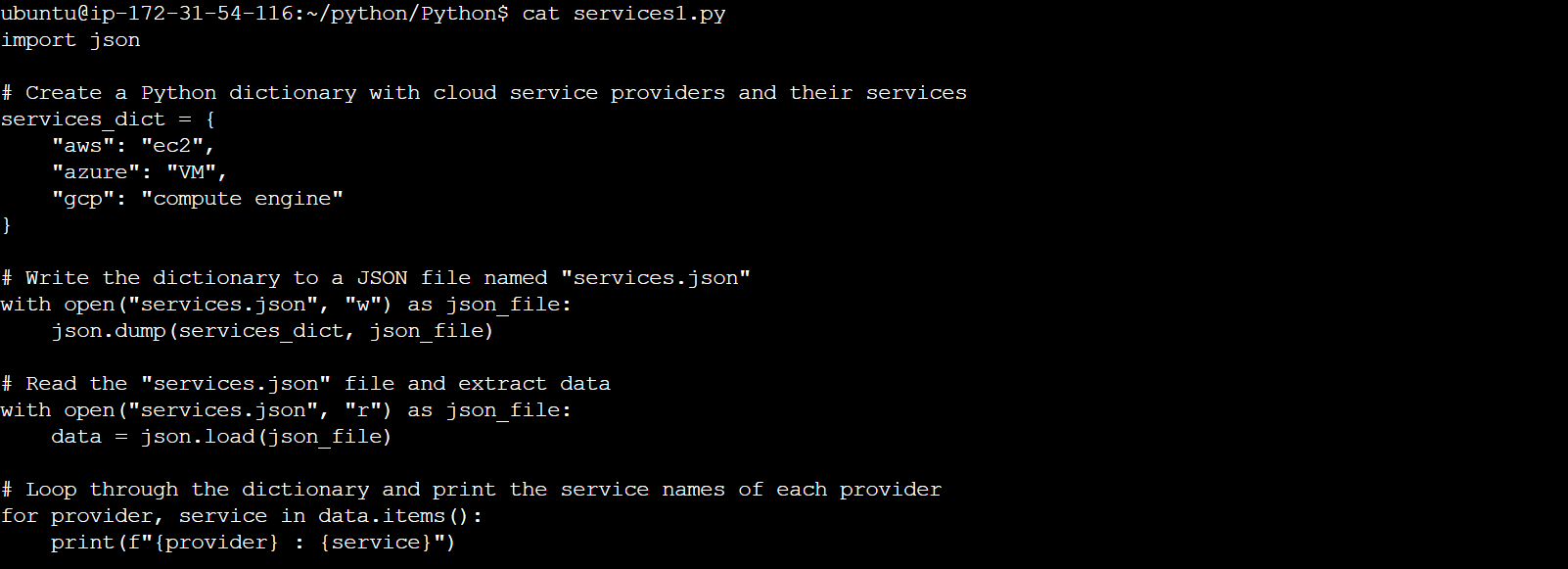

YAML:
YAML is a human-readable format.
It uses indentation and special characters to represent data.
The
pyyamllibrary in Python is used to handle YAML data.With
pyyaml, you can convert YAML data to Python objects (yaml.load()) and Python objects to YAML data (yaml.dump()).YAML is often used for configuration files.